The Better Bumper
Overview
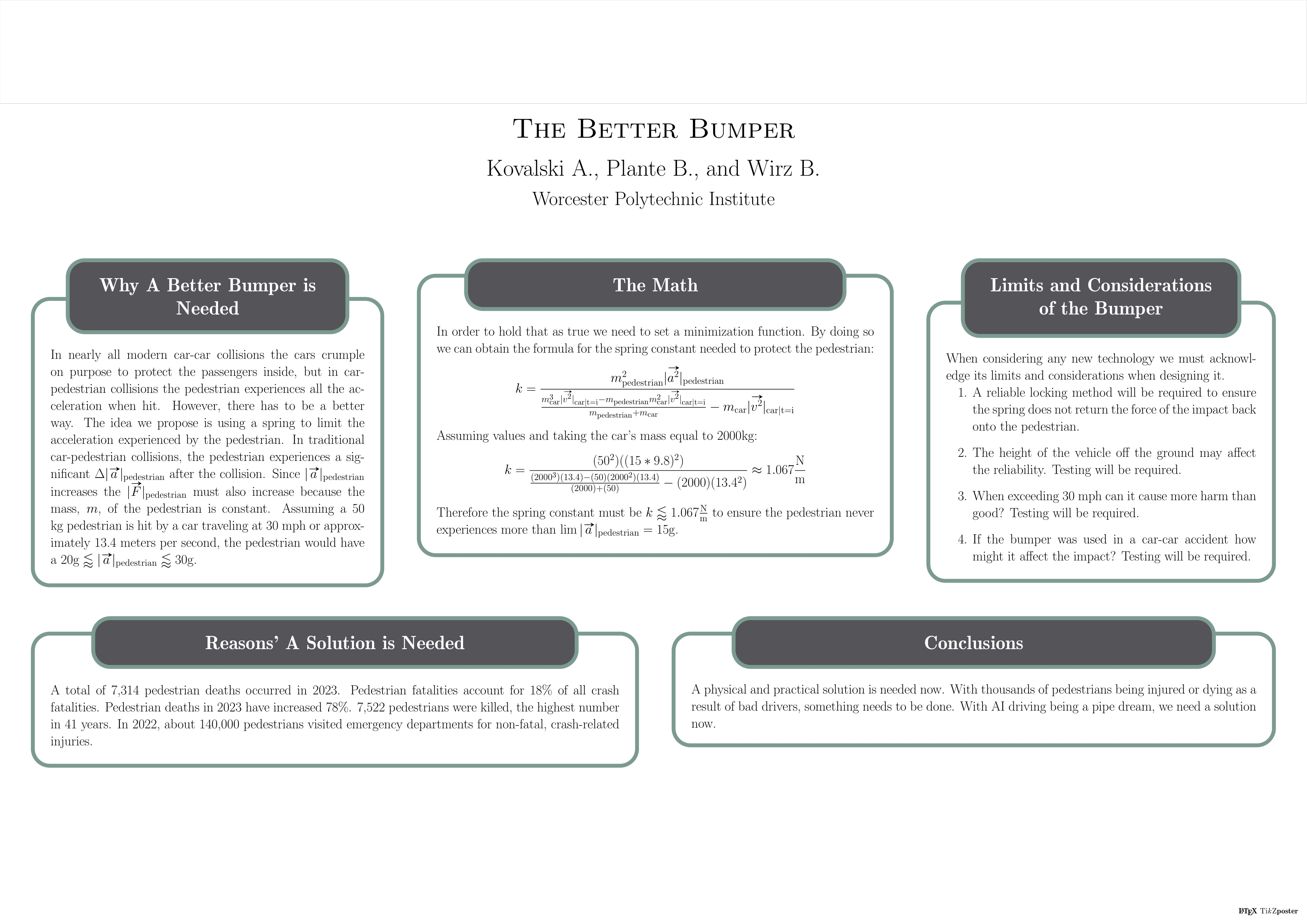
Modern cars are designed to crumple during car-to-car collisions to protect the occupants. However, in car-pedestrian collisions, the pedestrian absorbs nearly all of the acceleration, often resulting in severe injury or death. This project investigates whether a spring-based bumper system could reduce the acceleration experienced by a pedestrian during impact.
Why a Better Bumper Is Needed
In a typical car-pedestrian impact, the pedestrian experiences a sudden and extreme change in acceleration. Because the pedestrian’s mass remains constant, any increase in acceleration directly increases the force applied to their body.
For a 50 kg pedestrian struck at 30 mph (about 13.4 m/s), the resulting acceleration is generally in the range of 20 to 30 times the force of gravity, which is far beyond safe limits and commonly leads to life-threatening trauma.
Concept: A Spring-Based Impact System
The idea is to integrate a compliant spring or spring-damper mechanism into the vehicle’s bumper. Increasing the impact duration reduces the peak acceleration because the same amount of momentum must be changed over a longer time. A compliant bumper spreads the deceleration out, reducing the instantaneous force applied to the pedestrian.
Mathematical Model (Explained Without Equations)
A model was developed to estimate how stiff the bumper spring can be while still keeping the pedestrian’s acceleration below a safe limit. Using realistic numbers:
- A 50 kg pedestrian
- A 2000 kg vehicle
- A collision speed of 30 mph
- A target maximum of 15 g of acceleration to the pedestrian
The analysis shows that the spring must be very soft, with a spring constant of approximately 1 newton per meter or less. This means the bumper would need to compress significantly to keep the pedestrian safe.
Limits and Design Considerations
Several practical challenges must be addressed when developing this bumper:
-
Preventing Rebound
A locking mechanism must stop the spring from bouncing back and pushing force back into the pedestrian. -
Vehicle Height Differences
The system must work across various vehicle types and bumper heights. -
High-Speed Collisions
Impacts significantly above 30 mph may behave differently; crash testing is required. -
Behavior in Car-Car Collisions
A spring-based bumper changes how cars absorb energy when hitting another vehicle, so this must also be tested.
Why This Matters
Pedestrian injuries and deaths continue to rise:
- Over 7,300 pedestrian deaths occurred in 2023
- Pedestrians make up 18% of all crash fatalities
- Fatalities have increased 78% over the past decade
- More than 140,000 pedestrians visited emergency departments for non-fatal crash injuries in 2022
A practical and immediate safety improvement is urgently needed.
Conclusion
This project proposes a spring-based bumper system designed to reduce peak forces on pedestrians by increasing the duration of impact and lowering acceleration. While more analysis and testing are needed, this approach shows potential for significantly improving pedestrian safety.
The goal is simple: design a bumper that protects people outside the vehicle, not just the ones inside.